UVSIB — Automated Catalyst Discovery Pipeline
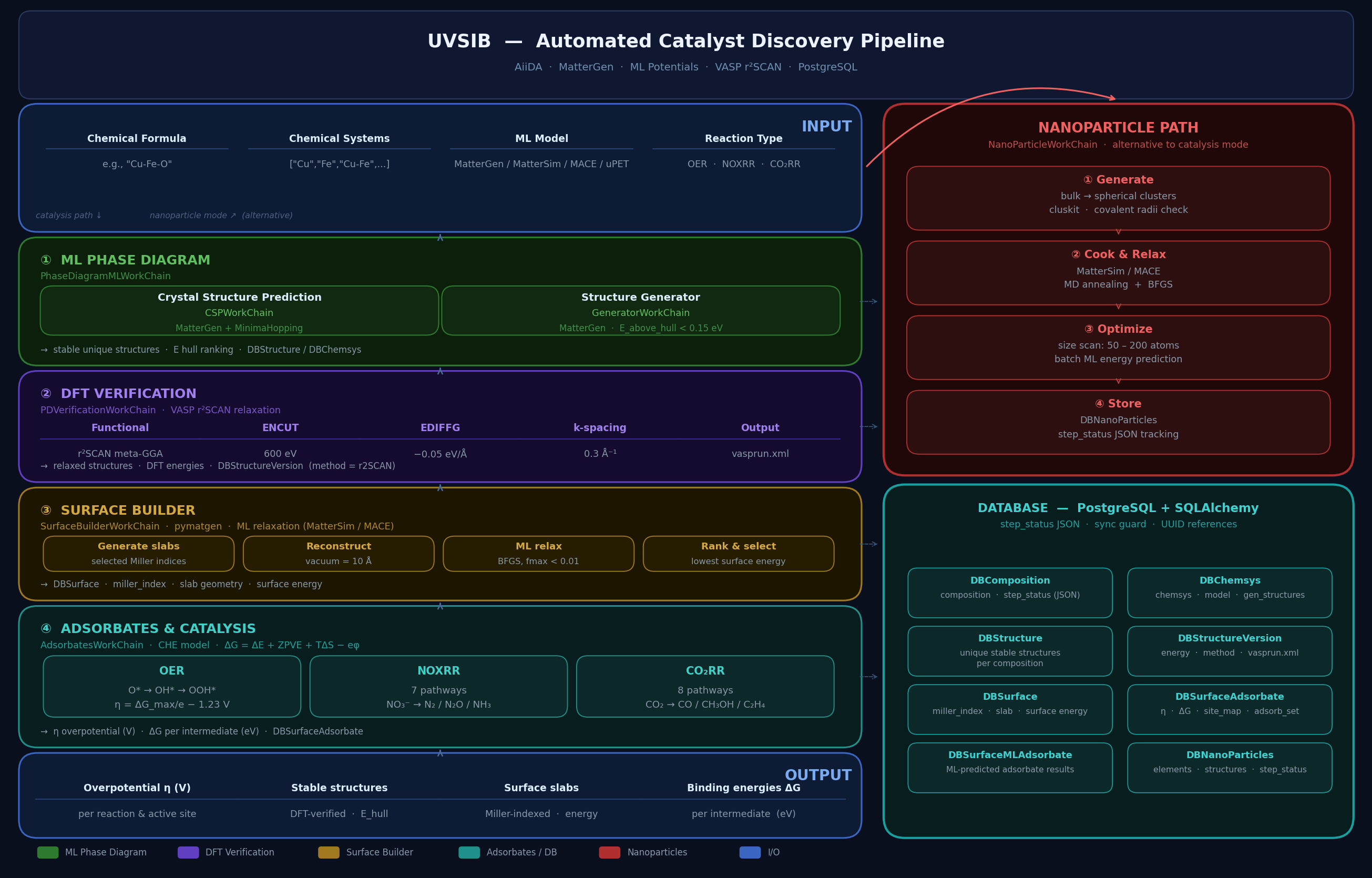
End-to-end AiiDA workflow for high-throughput catalyst screening: from chemical composition inputs through ML-accelerated structure generation, DFT verification, surface construction, and adsorption free energy evaluation, all stored in a PostgreSQL database via SQLAlchemy.
UVSIB integrates five computational stages into a single automated pipeline. Crystal structures are generated and ranked by ML phase diagrams (MatterGen + CSPWorkChain), verified by VASP r²SCAN DFT, sliced into surfaces by pymatgen and ML-relaxed (MatterSim / MACE), and finally evaluated for OER, NOXRR, and CO₂RR activity via the computational hydrogen electrode. A parallel nanoparticle path generates and optimises spherical clusters for size-dependent activity studies. All results are persisted in a normalised PostgreSQL schema with UUID references and JSON step-status tracking.
Related Software & Databases
External tools, codes, and databases that underpin the research workflows on this site.
All-electron density functional theory code based on numeric atom-centered orbitals. Combines high accuracy (no pseudopotential approximation) with efficiency for molecules and periodic solids. Used for high-precision total-energy benchmarks and reference calculations.
fhi-aims.org ↗Vienna Ab initio Simulation Package — the workhorse plane-wave DFT code for periodic systems. Used throughout the UVSIB pipeline for r²SCAN meta-GGA structure verification and adsorption energy calculations on catalyst surfaces.
vasp.at ↗Primary programming language for all workflow scripting, data analysis, and machine learning integration. The scientific Python ecosystem — NumPy, SciPy, matplotlib, pandas, and PyTorch — provides the computational substrate for post-processing and ML training.
python.org ↗Long-timescale dynamics code implementing adaptive kinetic Monte Carlo (aKMC), minimum mode following, and parallel replica methods for rare-event exploration. Used for saddle-point searches and identifying diffusion and reaction pathways on catalyst surfaces beyond MD timescales.
theory.cm.utexas.edu/eon ↗High-throughput DFT database hosting computed crystal structures, formation energies, phase diagrams, band structures, and elastic properties for >150 000 inorganic compounds. Primary reference for bulk stability screening and initial structure inputs in the UVSIB pipeline.
materialsproject.org ↗Atomic Simulation Environment — Python library for building, manipulating, and analysing atomistic structures and simulations. Provides a unified interface to DFT codes, ML potentials, and structure builders; used extensively for geometry manipulation, surface slab construction, and trajectory analysis throughout all workflows.
ase-lib.org ↗